


August 19, 2026
Miriam de Jong
Life with Myeloma: A juggling act
[Editor’s note: Miriam de Jong’s story was originally published in the Toronto Support Group’s newsletter and has been updated since its original publication in April 2026]
My myeloma journey started months before I was officially diagnosed in February 2024 at age 53. When the diagnosis finally came, it was actually a relief. Finally, an explanation for all the pain and my inability to lift my arms.
Early symptoms: Bone pain
Things started in the fall of 2023. Over Thanksgiving weekend, I had COVID and coughed so much that I assumed I had pulled muscles in my ribs. That had happened before. After recovering from COVID, I got bronchitis in November, which brought more coughing and more pain. By December, I felt well enough to travel to Colombia with my husband Juan to visit his family. I still had rib pain, but I took things easy. Colombia’s roads are not smooth, and every time we hit a bump in the car, I had to clutch my chest.
In January, things got much worse. My back hurt, my shoulders hurt, and I had trouble lifting my arms. My family doctor sent me for blood tests, which came back normal. She even tested me for exotic mosquito-borne diseases because of the bites I had gotten in Colombia. That came back negative too. By the end of January, I could no longer lift my arms at all. Juan had to help me shower and get dressed. When my doctor sent me for an X-ray, she called me that same night. The radiologist had found a lytic lesion in my left shoulder.
[Editor’s note: If you’re experiencing bone pain, Myeloma Canada’s Guides, Managing Pain and Fatigue, and Myeloma Bone Disease can help you get more informed. Always discuss pain and other symptoms with your care team.]
Diagnosis: CT scan, a trip to emergency, and a bone marrow biopsy
A CT scan at North York General Hospital (NYGH) revealed multiple old fractures in my thoracic spine and ribs, but no myeloma. Blood tests then showed very high calcium levels, and the internal medicine doctor suspected myeloma. She gave me two choices: wait for a referral to a hematologist, or go to the emergency room, where the pain and calcium levels would guarantee admission.
On February 13, Juan and I showed up at the NYGH emergency room. I did not leave the hospital until the second week of March. In addition to multiple healed rib fractures, I had four vertebral fractures, a fractured sternum, and lytic lesions in my left shoulder, pelvis, and left femur. My pain was difficult to control, but the NYGH palliative team was extraordinary. Once I was admitted, the pretense of being strong crumbled completely. At one point I was on more than 20mg of hydromorphone every eight hours, with breakthrough doses on top of that. Because of all the pain medications, the bone marrow biopsy was a breeze. When those results came in, the diagnosis of multiple myeloma was confirmed.
Induction therapy, stem cell transplant, and recovery
Induction therapy was rough. I was on dexamethasone, lenalidomide, and bortezomib, and I lived for the week off. During that time, I found the Toronto Myeloma Support Group and the Earl Bales walking group. The first time Juan and I attended an in-person support group meeting, I looked around the room and thought, I am the youngest person here by a lot. Most of the other members were retired or had stopped working. But what struck me most was how much knowledge was in that room. People answered our questions, shared their experiences, and made us feel less alone.
In May 2024, I had my first appointment with Dr. Bhella at Princess Margaret Hospital (PMH). My stem cell harvest happened at the end of June, and I was lucky enough to collect enough stem cells in a single session. My transplant took place in early July as an outpatient procedure. I do not remember much of those two weeks. I know I forced myself to drink more than two litres of liquid every day and that I spiked a fever once and had to stay overnight. The PMH staff were remarkable throughout.
After the transplant, I was referred to the Cancer Rehab and Survivorship program at Princess Margaret, which proved to be one of the most valuable parts of my recovery. Because of my vertebral fractures, I was connected with the kinesiologists at Wellspring Cancer Support Foundation who designed an exercise program specifically for me. Over the following months, I could feel myself getting stronger and building stamina. I also experienced side effects from lenalidomide maintenance, including neuropathy in my thumbs, diarrhea, and fatigue. My dose was adjusted twice. I am now on 5mg taken every other day, and the diarrhea has resolved completely, though fatigue is still something I manage every day.
In March 2025, I had kyphoplasty in six vertebrae. The recovery was more painful than expected and I ended up back on hydromorphone, but I got through it.
Returning to work: The part nobody talks about
Returning to work has been really hard, and I want to be honest about that, because I do not think it gets talked about enough.
I started a graduated return-to-work program in April 2025, supported by an occupational therapist from PMH who helped design accommodations including alternating in-person and work-from-home days. But the timeline my insurer expected was too aggressive. Both the occupational therapist from PMH and the occupational therapist that my insurer made me see agreed the plan needed to slow down. By the summer of 2026, I was working six hours, three days a week in person, and I was exhausted. Every increase in hours meant a decrease in everything else in my life.
I work at a university, running undergraduate teaching labs. The work itself is not beyond me. It is everything around it: getting up, getting dressed, taking the subway. I come home and make dinner, and that is the rest of the evening. There is no Pilates class, no gym. Just sleep and then doing it all over again.
Before my diagnosis, I was someone who lived to work. Now I want to work to live, but the irony is that working still takes so much out of me that I am back to living for work in a different way, and that frustrates me deeply.
I also want to say this, because I wish someone had said it to me: a cancer diagnosis will show you who your people are. I lost a friend who simply could not handle being around someone with cancer. But people I barely knew stepped up completely. You may be surprised where the support comes from, and that can be a gift even when the loss is painful.
The Scarborough Multiple Myeloma March
A few years ago, I became a co-organizer of the Scarborough Multiple Myeloma March. I was not working at the time, and it gave me a purpose and a goal. Going door to door to local businesses, asking for sponsorships, pushed me out of my comfort zone in a way that ended up being good for me.
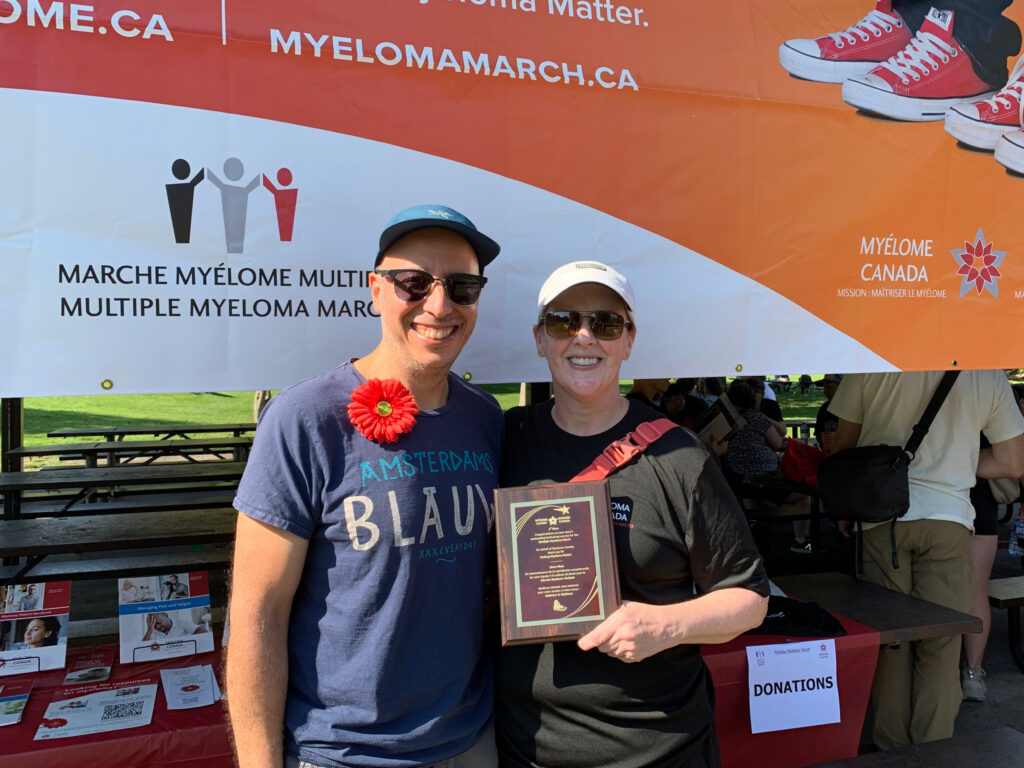
[Photo: At the Scarborough Multiple Myeloma March, 2025.]
Last year, I raised over $10,000, mostly from colleagues at work who had not known where I had been.
This year, things look a little different. I may not be able to do as much as I did in the past, but I am going to try. The March is my way of giving back for all the support I have received, and that matters to me.
What I would say to someone newly diagnosed
Find a support group! That is the first thing I would tell anyone.
When Juan and I googled multiple myeloma from my hospital bed, I noticed right away that the faces I saw did not look like me. I am not the demographic that usually shows up in search results. The Toronto Support Group skews older than I am, which is the reality of the disease, but there is still so much value in being in a room with people who are five, ten, twenty years into living with myeloma. Reading about it is not the same as meeting people who have it.
I would also say: take advantage of every free resource available to you. Wellspring, Myeloma Canada’s publications, online programs. The Understanding Your Blood and Blood Tests InfoGuide from Myeloma Canada was one of the first things I read, and it helped me understand what my team was tracking and why. Do not try to do this alone.
And finally, if you are working age and struggling with what a diagnosis means for your career, know that you are not the only one. It does not come up enough in the spaces where people talk about myeloma, but it is a real and complicated part of this journey.
[Editor’s note: The Young Patient and Caregiver’s Support Group meets virtually on Zoom and welcomes people across Canada living with myeloma, along with their caregivers, partners, family members, and friends, whose experiences may include balancing work, raising children, supporting loved ones, or managing other significant life responsibilities.]