



September 18, 2025
Dr Steven Shih
Dr Steven Shih on becoming a hematologist, the importance of clinical trials, and the future of myeloma care
Dr Steven Shih is a hematologist at the Cross Cancer Institute in Edmonton, specializing in myeloma and cellular therapy. His professional life has been shaped by unexpected opportunities and a deep commitment to improving access to treatment for people living with myeloma. In this interview, Dr Shih shares how clinical trials have become a cornerstone of his work, the role Myeloma Canada played in his career, and what inspires him about the future of myeloma research and care.
Myeloma Canada (MC): Could you tell us a little about yourself and how you became interested in hematology?
Dr Shih: I was recently hired as a hematologist specializing in myeloma and immune effector cell therapy at the Cross Cancer Institute in Edmonton. I just moved here last month, so I’m getting to enjoy the Edmonton summer before winter hits.
I was born in Taiwan but raised in Auckland, New Zealand. I did all my schooling there: medical school at the University of Auckland and my residency training, eventually qualifying as a clinical and laboratory hematologist.
You might be wondering why I came to this side of the world. I actually have some ties here and have lived here a few times. When I was 10, I lived in Vancouver, and that’s where I met my great-grandmother and some extended family, some of whom still live there today.
During my final year of medical school, I came to Canada for a medical student elective in Toronto and Montreal. I met some inspiring and excellent doctors at the time. I remember my Chief Resident said to me, “Hey, Steven, if you ever want to work in cancer, this is the place to be,” pointing to Princess Margaret Cancer Centre. That stuck with me. Years later, when I was choosing a fellowship, I came back to Princess Margaret.
MC: And how did you end up choosing hematology?
Dr Shih: That was quite serendipitous. I was finishing my first year of residency and thought I’d go into nephrology because my mentor at the time was a nephrologist. But then one of my senior residents called me, asking for help. He wanted to swap into internal medicine from hematology and finish his final six months of training there. He joked, “I’m married to a hematologist. I hear about it at home and now at work. I can’t take more!”
At the time, I knew nothing about hematology. As a junior doctor, hematology patients scared me because they were often the sickest. But I thought, if I want to learn, I should dive in. So, I agreed to the swap.
It was baptism by fire. I was reading every night, trying to understand what was going on. What started as my worst subject quickly became my best. At the end of the six months, my mentor said, “Steven, you’ve done really well. I can see you as a hematologist.” That’s how it all started.
MC: What drew you specifically to myeloma?
Dr Shih: Again, it was another chance encounter. I had just started advanced hematology training when a myeloma specialist in New Zealand, now also a mentor of mine who came to Canada as well, was looking for residents to help with a multi-center study to build a real-world database on myeloma patients in New Zealand. Me being a young, eager trainee, I raised my hand, and that became my first take at myeloma research. It ended up being a really good project which was published in the British Journal of Haematology.
The more I learned, the more I realized how complex and fascinating myeloma is, with all the different drugs, combinations, and sequencing strategies. But I also saw how patients in New Zealand were disadvantaged. It’s one of the worst countries in the OECD (Organization for Economic Co-operation and Development) for cancer drug access, and myeloma treatments are among the most expensive. New Zealand patients were getting the short end of the stick. I saw a high need, and I thought I could bring value. That’s why I stepped into clinical trial research. It was really the only way for patients to access novel therapies. It became a motivating factor for me and a lifeline for patients.
MC: Can you tell us about your research and practice?
Dr Shih: One of our main focuses is clinical trials. When we run a clinical trial, it’s not just to advance research. They’re also a way for patients to access novel therapies that they otherwise cannot access. We also target high-risk or relapsed myeloma patients who are less likely to respond to standard treatments.
I also do a lot of database research. At Princess Margaret, I worked with Dr Christine Chen on identifying transplant-eligible patients who might be more frail or prone to infections. We’re developing predictive tools to help with treatment selection and are now looking at how to better identify patients who are being considered for CAR-T therapy.
MC: Can you tell us a little about how Myeloma Canada has influenced your work?
Dr Shih: Myeloma Canada has actually been pivotal in my career. Within a month of starting my fellowship at Princess Margaret, my mentor Dr Suzanne Trudel invited me to help with a paper on Minimal Residual Disease (MRD) testing in Canada. It was at that kickoff meeting where I met Gabriele Colasurdo (Director of Research and Science at Myeloma Canada), Dr Hira Mian, Dr Irwindeep Sandhu (my current boss) and many other myeloma doctors from across the country.
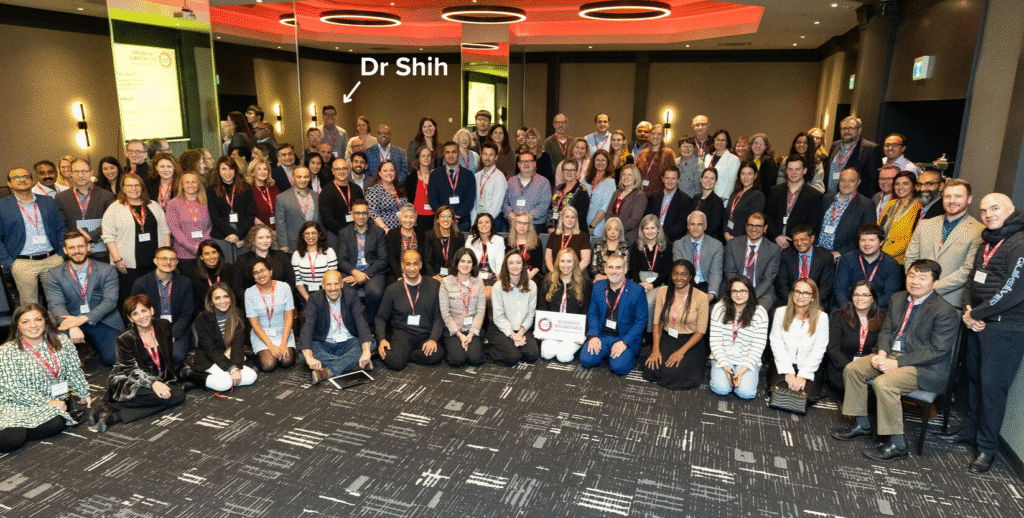
[Photo: Participants at the Myeloma Canada Scientific Roundtable in Montreal, 2024]
Gabriele then invited me to the Myeloma Canada Scientific Roundtable in Montreal, where I got to meet even more myeloma doctors. Several people were trying to convince me to stay in Canada. At the Roundtable, Dr Trudel and Dr Chen kept saying to everyone, “I’m trying to keep Steven here, and I know all of you are looking for an academic myeloma doctor.” That’s when Dr Sandhu stood up and said, “I’m looking for someone like that!”
It’s funny because I almost didn’t make it to the Roundtable, but Gabriele helped me get there. So yes, Myeloma Canada has played a huge role in my journey.
Note: Dr Shih was one of Myeloma Canada’s Dr Andrew Belch MEET grant recipients in 2024. MEET grants are intended to support young investigators in their enriched training activities like travelling to international conferences. Young academic doctors like Dr Shih are our future. They provide hope to so many people who live with myeloma, or who will be diagnosed with the disease in the future.
MC: I know you’re doing work in Edmonton on homegrown CAR-T therapy. Can you say more about that work?
Dr Shih: CAR-T is very expensive. It’s the most expensive cancer treatment. There’s a need to make it more economical, less toxic, and more effective. Homegrown CAR-T gives us more control and can be produced at about one-tenth of the cost. As you know, Dr Michael Chu has been leading this incredible program at the Cross Cancer Institute, and I’m fortunate to be working alongside him.
Note: Homegrown CAR-T refers to CAR T-cell therapies that could be manufactured in Canada (maybe even at a hospital), as opposed to shipping the patient’s T-cells to a factory in the United States or elsewhere to make the treatment.
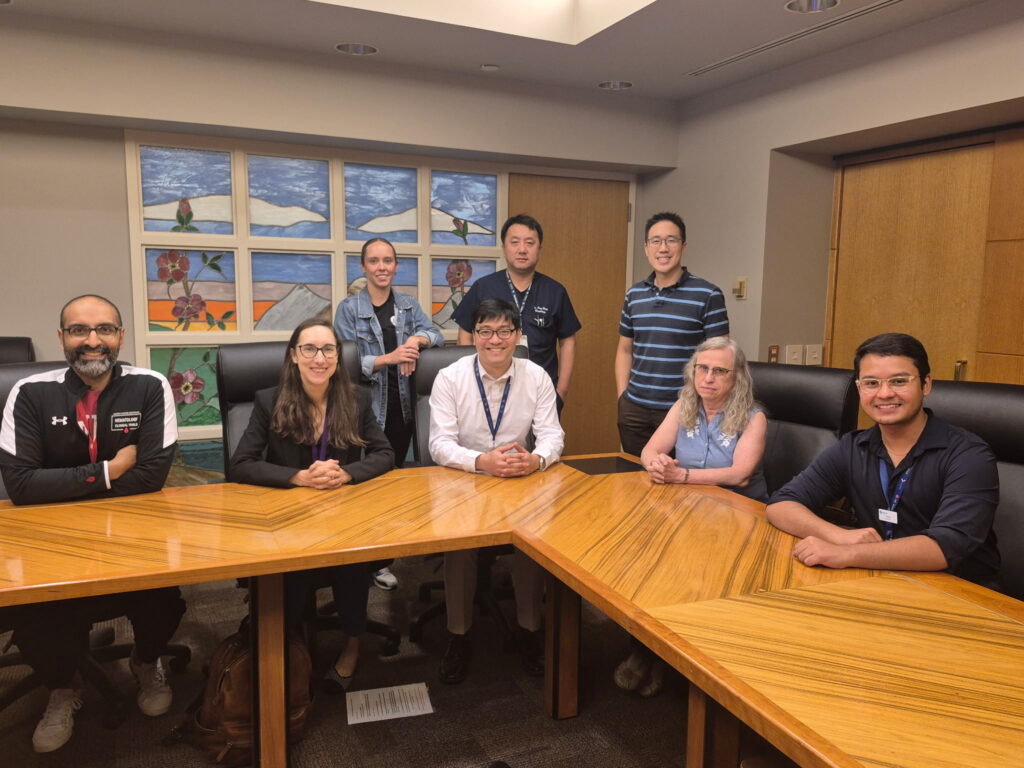
[Photo: Dr Shih (centre) and myeloma team at the Cross Cancer Institute in Edmonton, 2025]
MC: From an access perspective, what do you see as the future of homegrown CAR-T?
Dr Shih: It’s tricky. Once commercial CAR-T becomes available, patients may prefer it. But even commercial manufacturing capacity is limited, and homegrown CAR-T can help meet the demand. If it’s cheaper and less toxic, it becomes a valuable option.
In Canada, we don’t yet have access to commercial CAR-T for myeloma. That’s still being negotiated, and it’s been in negotiation for a long time. From my point of view, there is an opportunity here for homegrown CAR-T to fill that gap, particularly if there’s ever a shortage.
Note: In the time between this interview and publication, negotiations regarding Carvykti (CAR T-cell therapy) were concluded without agreement. Myeloma Canada is committed to continuing advocacy for access to this important therapy.
MC: If you had one wish for people living with myeloma, what would it be?
Dr Shih: Well as you know, all the myeloma doctors wish for a cure or functional cure for their patients. But because everyone wishes for that, I’ll wish for something different.
Alongside longevity, I would like to maintain a good quality of life for my patients. I want them to spend the time they have with their family, friends, loved ones, and to do that without the financial burden of the disease.
I’ve seen so many families mortgage or sell homes to pay for treatments that aren’t even curative. I want to shield patients from that burden. I do that through clinical trials, compassionate access programs, and ongoing advocacy work so that they can get treatment funded through the public system.
MC: Is there anything else you’d like to add?
Dr Shih: Just that I’m committed to improving the lives of myeloma patients through research and advocacy. Myeloma Canada played a key role in my decision to stay in Canada and helped me find my current position. Now it’s my turn to give back.
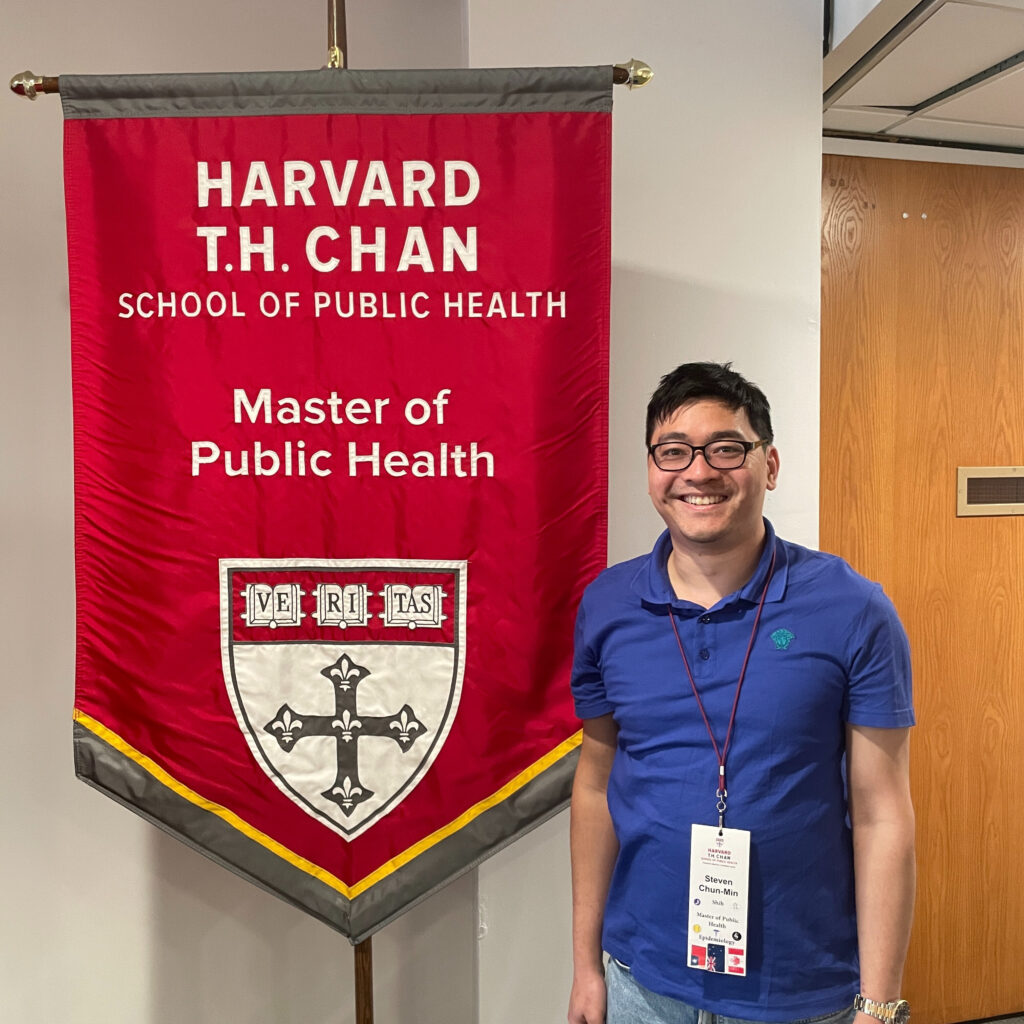
[Photo: Dr Shih enrolled in Master of Public Health in Epidemiology at the Harvard T.H. Chan School of Public Health in 2025]
Thank you, Dr Shih!
We are so grateful for Dr Shih for sharing his story and insights. His dedication to clinical research and equitable access to treatment is deeply appreciated within the Canadian myeloma community. We look forward to seeing the impact of Dr Shih’s work in the years ahead.