
October 26, 2026
The Promise … and the Waiting: A New Era in Myeloma Treatment

When I think about the impact of new myeloma treatments, one word keeps coming to mind: time.
Over the past 10 years, I have watched myeloma research advance at a pace I had never seen. New treatments are being developed with extraordinary speed, and the time between scientific discovery and meaningful clinical results is becoming shorter. We are seeing deeper responses, longer remissions, possibilities including treatment-free remission, and even cure that once seemed out of reach.
At the same time, however, it is taking longer for many of these innovations to reach patients. Regulatory reviews, health technology assessments, price negotiations, provincial funding decisions and implementation can add years to the process. This growing gap between the speed of scientific discovery and the speed of patient access concerns me deeply. For people whose myeloma is progressing, there is no time to wait for heavy processes. Every delay can mean more disease progression and fewer moments with family.
This is why I believe the time to build in Canada is now
We must invest in Canadian research, clinical trials, treatment infrastructure, and health-system capacity so that our country is prepared not only to help develop the next generation of therapies, but also to deliver them to patients quickly and sustainably. Canadian researchers and clinicians are contributing to extraordinary advances. Canadian patients should have the opportunity to benefit from them.
Building in Canada also means finding innovative solutions to the barriers that separate patients from treatment. Healthcare may be administered provincially, but myeloma does not recognize provincial borders. We cannot allow our provincial healthcare structures to become walls that prevent national progress. We need solutions that respect provincial responsibilities while creating greater consistency, collaboration, and equity across the country. That may mean shared treatment networks, interprovincial referral pathways, coordinated data systems, and new funding models for highly specialized therapies.
This tension was especially clear at the 2026 International Myeloma Society (IMS) Annual Meeting. The science presented at this major myeloma research conference offered tremendous reasons for hope, but it also raised an urgent question: What is the value of a breakthrough if patients cannot access it when they need it?
These are extraordinarily hopeful times in myeloma, but hope must be matched by action. Science is moving faster than ever. Canada must now build the infrastructure, partnerships, and capacity needed to move with it. Together, we can create a more sustainable Canadian myeloma ecosystem, one in which research is supported here, innovation is brought here, and every patient has a fair opportunity to benefit here.
The time to prepare is not when the next breakthrough arrives. The time to build is now.
The good news: Treatments are working better and for longer
CAR T-cell therapy remains one of the most hopeful advances in myeloma. It reprograms a patient’s immune cells to find and destroy myeloma. Some heavily treated patients have remained alive and free of disease progression for five years or more after a single infusion, without maintenance therapy raising the possibility that some may be cured.
Bispecific antibodies are also producing deep responses by connecting immune cells directly to myeloma cells. Newer versions may require less frequent dosing and have more manageable side effects. Looking ahead, researchers are studying trispecific antibodies, which attack myeloma through multiple targets, and in vivo CAR T-cell therapy, which would create CAR T cells inside the patient. Although still experimental, these approaches could eventually reduce manufacturing delays and make advanced treatments available to more people.
Encouragingly, pCPA negotiations for Blenrep (belantamab mafodotin), an antibody-drug conjugate that targets myeloma cells, have successfully concluded. Provincial funding decisions are still required, but this brings patients closer to public access. Because Blenrep does not require specialized cell manufacturing, it may be offered closer to home, although regular eye monitoring is required.
For the newly diagnosed patient with myeloma, the PERSEUS trial offers remarkable hope: researchers estimate that treatment with daratumumab, bortezomib, lenalidomide, and dexamethasone followed by maintenance therapy could keep the disease from progressing for a median of approximately 17 years, although longer follow-up is needed to confirm this projection.
The more complicated news: Side effects are changing
Newer treatments do not always mean fewer side effects. Often, they mean different ones.
Immune-based therapies, for instance, can increase the risk of infections, low blood-cell counts, inflammation, and, less commonly, neurological problems. Some treatments also require hospitalization and close monitoring. The good news is that care teams are becoming better at preventing, recognizing, and managing these effects. The goal is not only to help patients live longer, but also to help them live well.
MRD is changing how we think about treatment
Measurable residual disease, (MRD) testing can detect very small amounts of myeloma, sometimes as little as one myeloma cell among one million normal cells.
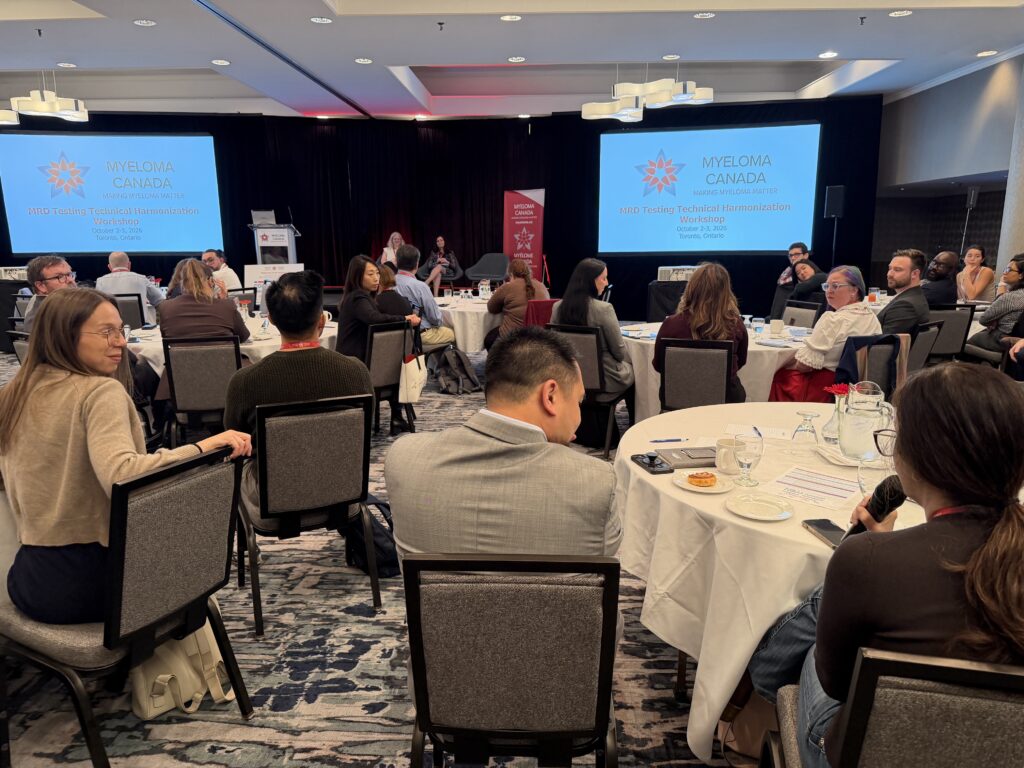
[Photo: Leaders in Canadian health care and myeloma research gathered to discuss MRD testing at a meeting hosted by Myeloma Canada this fall]
MRD testing helps show how well treatment is working. Researchers are studying whether the results can help determine who needs more treatment and who may be able to reduce or stop treatment safely.
Being MRD-negative does not guarantee that myeloma will never return. However, MRD testing is bringing us closer to treatment based on each patient’s response. This could mean less unnecessary treatment, fewer side effects and more time without therapy.
The hopeful news: We can finally define cure
Perhaps the most emotional moment at IMS was the presentation of a consensus definition of cure. Under this definition, a person with newly diagnosed or relapsed myeloma may be considered cured after remaining in complete remission and off all myeloma treatment for at least five years. During that time, repeated highly sensitive MRD tests and advanced imaging must show no evidence of disease.
This does not mean that everyone with myeloma can be cured today. Relapse remains a reality for many people, particularly those with high-risk disease. But the fact that leading clinicians and researchers can now define cure tells us how far the field has come. Myeloma is no longer being discussed only as a disease that must be treated continuously for life. The IMS/IMWG cure definition gives researchers a clear goal: deep, lasting and treatment-free remission.
Learn more about the discussion and development of the cure definition in our article on the subject.
The hard truth: Innovation without access is not progress for patients
These are extraordinarily hopeful times in myeloma. Treatments are becoming more effective, responses are lasting longer, care is becoming more personalized, and cure has entered the scientific conversation. But hope must be matched by action. A breakthrough matters to patients only when they can access it at the right time, regardless of where they live or their ability to pay.
Science is moving faster. Now our health systems must learn to move with it.