
October 26, 2026
Myeloma Canada at the International Myeloma Society Annual Meeting 2026: Key Takeaways
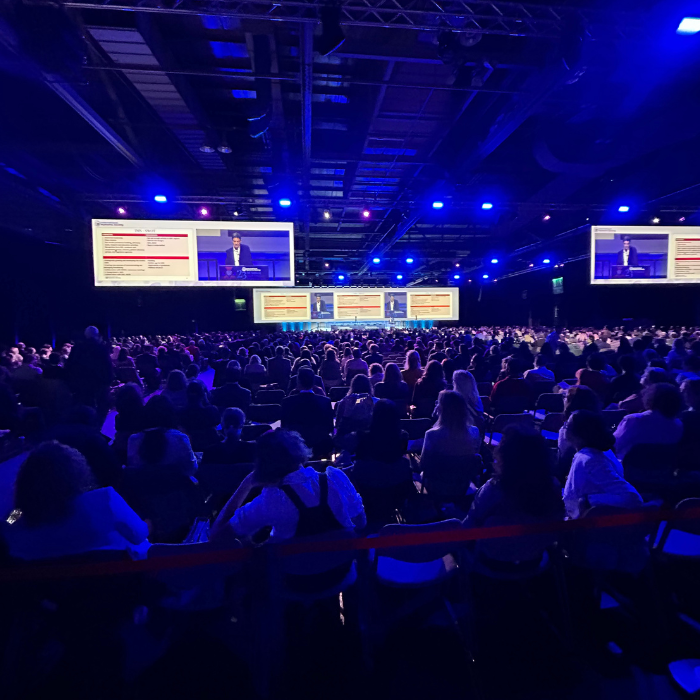
Every year, leading myeloma researchers and advocates from around the world gather at the International Myeloma Society (IMS) Annual Meeting. This year’s meeting in Glasgow drew over 30 Canadian researchers, and we were proud to see such strong representation of our country’s scientific community.
Myeloma Canada’s Martine Elias, CEO, Michelle Oana, Chief Mission Officer, and Gabriele Colasurdo, Director of Science and Research, were all in attendance. Below, they share their key takeaways from IMS 2026.
Martine Elias’s key takeaways:
The flattening of survival curves gives patients and researchers new hope for long-lasting, treatment-free remission
A very encouraging development discussed at the IMS meeting was the apparent flattening or plateauing of progression-free survival and overall survival curves with some newer treatments, particularly CAR T-cell therapies. A progression-free survival curve shows the proportion of patients who remain alive without their myeloma worsening, while an overall survival curve shows the proportion who remain alive over time. Historically, these curves in myeloma have continued to decline as more patients eventually relapsed or died.
When a curve begins to flatten, it means that fewer new relapses or deaths are being observed among the patients who have reached that point in follow-up. This raises the exciting possibility that some people may experience exceptionally long remissions and perhaps never relapse. For example, long-term CAR T-cell data have shown that some heavily pretreated patients remain alive and progression-free for five years or more after a single infusion, without ongoing maintenance treatment. This type of durable, treatment-free remission is one of the reasons experts can now seriously discuss the possibility of cure.
A plateau, however, is not by itself proof of cure. The number of patients being followed becomes smaller over time, and longer observation is needed to confirm that the curve remains stable. Overall survival can also be influenced by the treatments patients receive after a relapse. Nevertheless, seeing these curves begin to flatten represents an important change in the myeloma landscape. The goal is no longer only to delay the next relapse, but to identify which treatments and which patients can achieve deep, lasting and treatment-free remission. Read more from the International Myeloma Society article “Global Myeloma Experts Define Cure for a Disease Long Considered Incurable.”
Could today’s treatments allow some people with myeloma to live a normal lifespan after only one or two lines of therapy?
Another powerful message from the IMS meeting was that many people diagnosed with myeloma today may need only one or two lines of therapy during their lifetime. A “line of therapy” refers to a treatment plan used until it is completed, stopped or replaced — not simply one drug or one treatment cycle. Today’s first-line combinations can produce much deeper and longer-lasting remissions, while newer treatments available at first relapse, including CAR T-cell therapies, bispecific antibodies, and antibody-drug conjugates, may provide several additional years of disease control.
If the first treatment controls myeloma for many years and the second produces another prolonged remission, some patients particularly those with standard-risk disease, may never require a third line of therapy. Experts are therefore beginning to envision a future in which a person’s life expectancy is no longer determined primarily by myeloma. In other words, their survival curve could begin to resemble that of healthy people of the same age in the general population, with other age-related health conditions becoming more likely than myeloma to determine how long they live.
This is an encouraging projection, not yet a guarantee for every person diagnosed today. Outcomes vary according to age, overall health, disease biology, treatment response and access to new therapies, and people with high-risk myeloma continue to face greater challenges. Nevertheless, the fact that experts are now discussing normal life expectancy after only one or two lines of treatment reflects how dramatically the field has changed. It reinforces the importance of ensuring that Canadian patients have timely and equitable access to the therapies making this future possible. Hear the IMS 2026 perspective from Dr. Luciano Costa.
New approaches that could make treatment simpler
One of the most encouraging surprises for me was iberdomide, a drug belonging to a new class of oral drugs called CELMoDs. This treatment is designed to work more powerfully and precisely than older drugs in the immunomodulatory family, such as lenalidomide and pomalidomide.
Among patients receiving iberdomide with daratumumab and dexamethasone, 41.1% achieved a complete response with no myeloma detected using a highly sensitive test. Given that it is taken orally, it is also more convenient to manage. Even so, the deep responses seen with this convenient oral therapy are very promising.
Michelle Oana’s key takeaways
Will a transplant still be necessary?
For more than 30 years, an autologous stem cell transplant has been a standard part of treatment for many people newly diagnosed with myeloma. But with the incredible number of new and highly effective treatments now available, researchers are finally asking an important question: does everyone still need a transplant?
Several studies are now looking at whether some people can achieve the same or potentially better results using newer treatments and treatment combinations without going through a transplant.
This is a huge shift. We are talking about reconsidering an approach that has been part of myeloma treatment for newly diagnosed patients, for decades. The early results are promising, but it is still too soon to know what this will ultimately mean for patients. The studies need time to mature, and we need longer term results. But the fact that this question is finally being seriously studied is, in itself, a major development.
Less to no dexamethasone. Fewer treatments. Fewer trips to the hospital.
Another theme that really stood out was the growing number of treatments and clinical trials looking at “dex free” approaches. Dexamethasone has been an important part of myeloma treatment for decades, but it can also cause significant side effects, such as high blood sugar, weight gain, sleep problems, and mood changes, among others. Researchers are increasingly asking whether we can still achieve excellent results while reducing or eliminating it altogether.
We are also seeing new approaches that could make treatment much simpler. For example, etentamig, a new bispecific antibody currently being studied in clinical trials, is being evaluated as a single treatment given once a month from the beginning of therapy. Early results are encouraging, and some of these newer approaches are showing results that compare favorably with more complicated treatment combinations, while conveniently requiring fewer visits to the hospital for treatment, with less side-effects.
Gabriele Colasurdo’s key takeaway
Expanding options if myeloma returns
The possibility of cure is becoming an increasingly important part of the myeloma conversation at IMS and elsewhere. As more people achieve longer remissions, the hope is that a growing proportion could eventually live free of both myeloma and treatment. For patients, that changes the outlook. Relapse may increasingly become an “if,” rather than an inevitable “when.”
But progress must reach more than those experiencing the longest remissions. People living with high-risk myeloma may achieve a deep initial response, but the disease can still return sooner and remain harder to control. They will continue to need better treatment options.
That is why the expanding range of treatments is so encouraging. CAR T-cell therapies, bispecific antibodies, antibody-drug conjugates, and CELMoDs are creating more possibilities if myeloma returns. Some treatments target proteins beyond BCMA, including GPRC5D and FcRH5, although some of these approaches remain investigational. Researchers are studying how best to use these options to regain disease control and prolong remission.
The next generation is also taking shape. Investigational trispecific antibodies and dual-targeted CAR T-cell therapies are designed to recognize more than one target on myeloma cells, potentially making it harder for the disease to escape treatment. Researchers are also developing in vivo CAR T-cell therapy, which creates modified immune cells directly inside the body. These approaches remain experimental, with more evidence needed on safety and lasting benefits.
In this new era, progress also means treatment that is easier to live with. Fewer doses, hospital stays, and trips to a treatment centre can mean more time for family, work, and everyday life. Expanding access to these therapies will be essential so that both the prospect of cure and better options if myeloma returns become meaningful possibilities for more people.