


October 26, 2026
Defining Cure in Multiple Myeloma
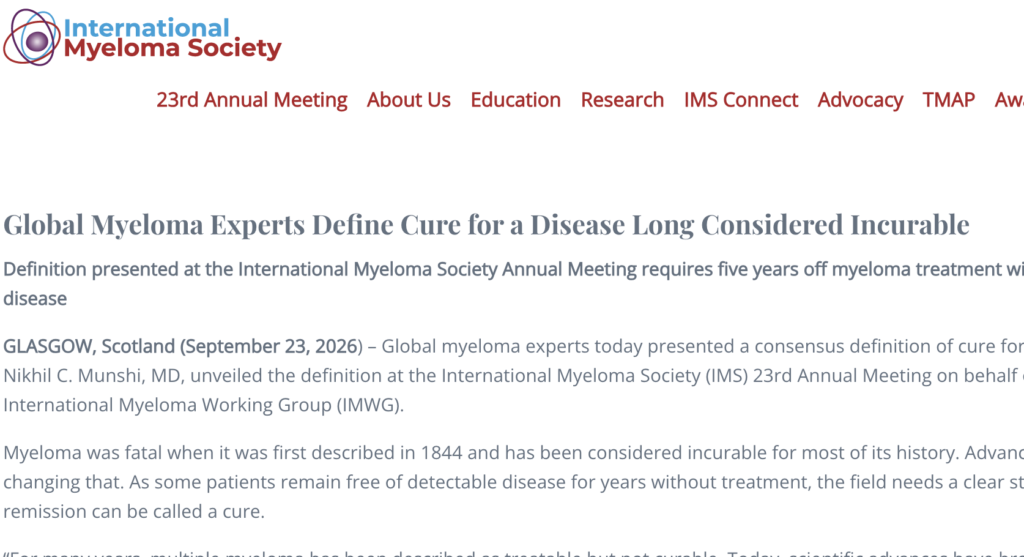
Since it was first described in 1844, multiple myeloma has largely been considered incurable. Now, for the first time, the International Myeloma Society (IMS) and International Myeloma Working Group (IMWG) have proposed a consensus definition of what cure means in myeloma. Dr. Nikhil Munshi presented the definition on September 23, 2026, at the IMS Annual Meeting in Glasgow: a durable, treatment-free remission so deep and sustained that myeloma cannot be detected using highly sensitive tests. The definition is very much a clinical definition, and may not reflect how a patient feels, but it does provide hope for the future of myeloma care.
Why define cure now?
This topic is receiving increasing attention in research forums because there has been continued improvement in survival over the last 20 years. In Canada, five-year net survival for myeloma rose from 27% for people diagnosed in 1992–1994 to 54% for those diagnosed in 2019–2021 [1]. Responses to treatment have also become deeper and are lasting longer. One striking example is CARTITUDE-1, in which 32 of 97 heavily pretreated patients were alive and progression-free for at least five years after a single infusion of the CAR T-cell therapy cilta-cel, with no maintenance treatment [2, 3]. Another example is CARTITUDE-2 Cohort A, which studied cilta-cel earlier in the treatment course (one to three prior lines of therapy). Ten of 20 patients in that study remained alive and progression-free for at least five years without further myeloma treatment [4]. As Dr. Munshi put it, “the depth and durability of response now make cure something to measure, not just hope for” [5]. With continued advances, including the development of new therapies and the earlier use of effective treatments, the proportion of people experiencing this level of long‑term control is expected to rise over time. Myeloma research is advancing faster than ever, bringing more encouraging outcomes and new hope for people affected by the disease.
So what counts when assessing cure?
Under the proposed definition, a patient with newly diagnosed or relapsed myeloma may be considered cured after five years in complete remission with no myeloma treatment. The clock starts the day treatment stops, so time spent disease-free while still on drugs does not count toward a cure assessment. Over those five years, three conditions must be met [3]:
- At least four measurable residual disease (MRD) tests come back negative. A negative MRD test means no myeloma cells could be detected at the level of sensitivity of the specific test. One of the tests must be done at the five-year mark, and no test in between can be positive.
- The MRD tests are extremely sensitive. Several types of MRD test are available or in development. The MRD tests required to meet the definition of cure must be able to find a single myeloma cell among one million cells (written as 10⁻⁶), using next-generation sequencing or next-generation flow.
- Advanced imaging scans show no disease. A PET/CT or diffusion-weighted whole-body MRI must show no disease at the start and at the end of the five years, and any additional scan in between must also be clear.
The off-treatment rule is key because it separates a cure from a cancer that is simply being held down by ongoing drugs. Five years was chosen because myeloma data show relapse becomes much less likely after that point, a pattern also seen in other cancers such as Hodgkin lymphoma and testicular cancer [3].
In real-world practice, MRD testing is not yet appropriate or available for every patient, and decisions about testing and treatment should always be individualized with the care team. Importantly, not meeting the proposed definition of cure does not mean treatment has failed or that long-term remission cannot be achieved.
What comes next?
For the first time, patients and clinicians share a clear, measurable standard for cure. However, confirming a cure relies on ultra-sensitive MRD testing and advanced imaging that are not yet routinely available across Canada [6]. The next step is to improve access to MRD testing and to effective treatments that can produce deep, durable remissions. The good news is that MRD testing and treatments are advancing quickly [3], and patients can be part of that progress by asking their care team about MRD testing and what it could mean for their treatment. The great news is that myeloma, once considered a disease that could only be managed, is now, as Dr. Munshi put it in his closing remarks, “a curable malignancy” for some people [5].
References
- Statistics Canada. Cancer survival statistics, 1992 to 2021. The Daily. 2025 Aug 13. Available at: https://www150.statcan.gc.ca/n1/daily-quotidien/250813/dq250813a-eng.htm.
- Jagannath S, Martin TG, Lin Y, et al. Long-term (≥5-year) remission and survival after treatment with ciltacabtagene autoleucel in CARTITUDE-1 patients with relapsed/refractory multiple myeloma. J Clin Oncol. 2025;43(25):2766–2771. Available at: https://doi.org/10.1200/JCO-25-00760.
- International Myeloma Society. Global myeloma experts define cure for a disease long considered incurable [press release]. 2026 Sep 23. Available at: https://www.myelomasociety.org/ims-news-room/myeloma-cure/.
- Cohen AD, Mateos MV, Cohen Y, et al. Long-term (≥5-year) remission and survival with ciltacabtagene autoleucel in relapsed/refractory multiple myeloma with 1-3 prior lines of therapy: CARTITUDE-2 Cohort A. Poster #PA-288. Presented at: 23rd IMS Annual Meeting and Exposition; Sep 23-26, 2026; Glasgow, Scotland.
- Munshi NC. IMS/IMWG Consensus Update. Presented at: 23rd International Myeloma Society Annual Meeting and Exposition; 2026 Sep 23–26; Glasgow, Scotland
- Mian HS, Visram A, Shih SC-M, et al. Minimal residual disease testing infrastructure in multiple myeloma: guidance for clinical trial and routine practice use in Canada. Clin Lymphoma Myeloma Leuk. 2025;25(6):e404–e410. Available at: https://doi.org/10.1016/j.clml.2025.01.010.