


July 23, 2026
Key Takeaways from the Global Myeloma Action Network (GMAN) Summit
By Michelle Oana, Chief Mission Officer, Myeloma Canada
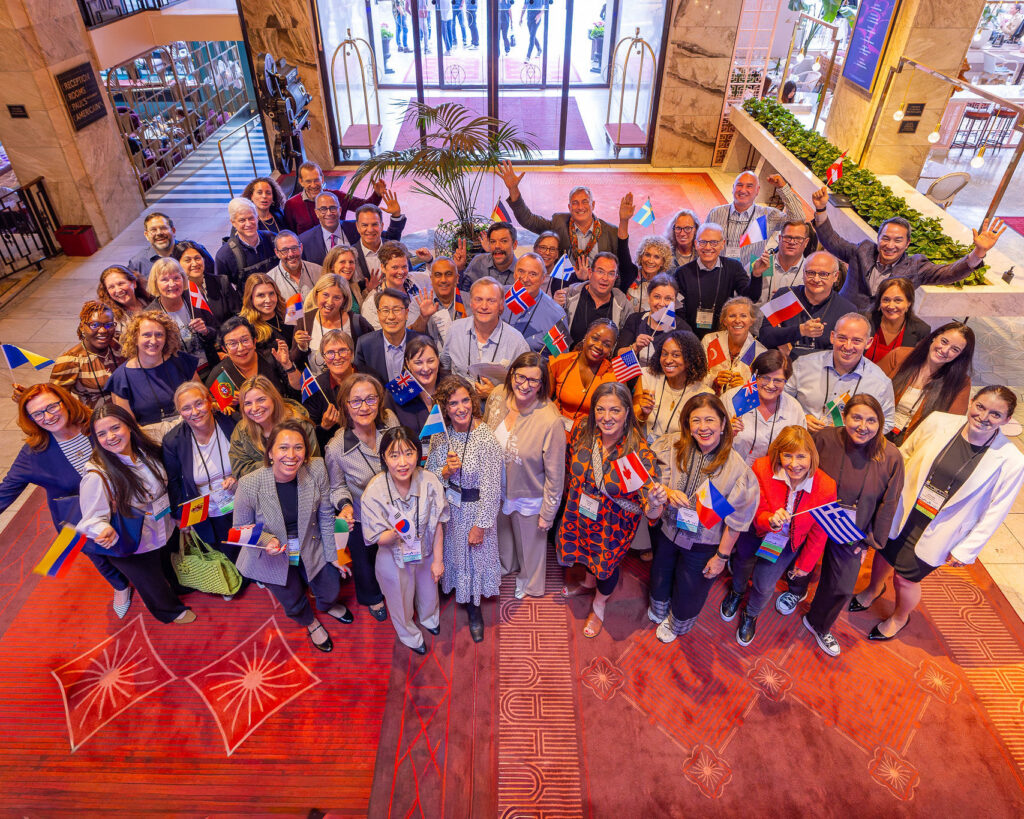
Myeloma Canada was honoured to participate in the 12th annual Global Myeloma Action Network (GMAN) Summit in Stockholm on June 5-7, hosted by the International Myeloma Foundation (IMF). I was proud to represent Myeloma Canada alongside more than 20 network members from countries across North and South America, Europe, Africa, Asia, the Middle East, and Australia. It was an inspiring event that brought together the global myeloma community to learn from one another, exchange ideas, and explore new pathways to improve access to innovation and quality care for myeloma patients worldwide.
During the World Café panel session, I was proud to present Myeloma Canada’s initiative to standardize the implementation of minimal residual disease (MRD) testing in Canada, a highly sensitive tool for detecting very low levels of myeloma in the body. I shared how our organization is bringing key players together to collaborate and move forward in a unified manner. Myeloma Canada is the first and only patient organization to lead an initiative of this kind.
Historic commitments toward improving equity in access to treatments
One of the most significant outcomes of the meeting was a commitment from the GMAN to jointly develop, with clinicians and researchers, a global treatment guideline outlining the minimum standard of myeloma treatment that every country should have access to, regardless of geography. We, as Canadians, are relatively lucky to have access to care and innovation compared to many of the other countries across the globe. To put this into perspective, some countries still struggle to access bortezomib, now a generic treatment that was approved in Canada in 2005. This historic commitment represents an important step toward improving equity in access to care around the world, and we are proud to be part of this effort.
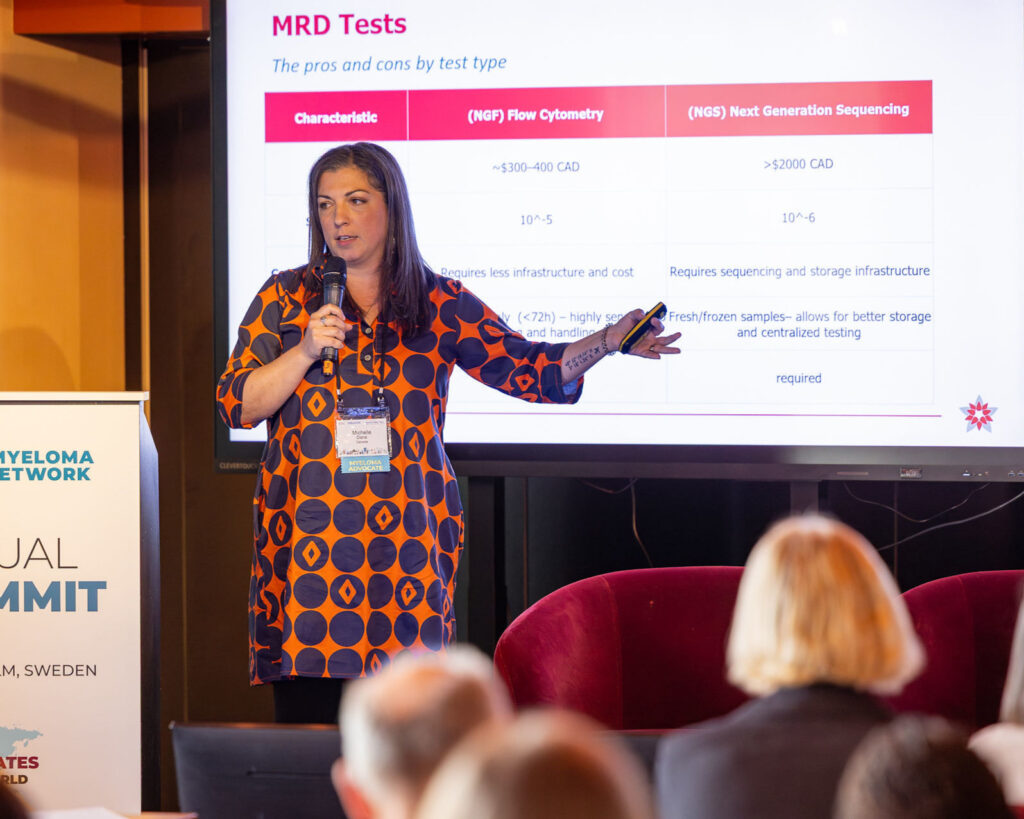
[Photo: Michelle Oana, Chief Mission Officer, Myeloma Canada, at the 12th annual GMAN summit in Stockholm. Presentation on Myeloma Canada’s initiative to standardize the implementation of minimal residual disease (MRD) testing in Canada.]
From a research perspective, so much is happening, and so fast.
Here are just a few highlights that caught my attention that will likely move the field of myeloma treatment forward for years to come:
“Quad” therapies pack a punch
As we have learned over time, two drugs are more effective at treating myeloma than one drug, three drugs are more effective than two drugs, and more recently, four drugs (or quads) are more effectivethan three drugs. More specifically, quad therapies in newly diagnosed myeloma pack a punch, and potentially even more so as newer quad therapy combinations are being studied in clinical trials. For example, a study using fixed-duration IberDVd (iberdomide, daratumumab, bortezomib, and dexamethasone) as an up-front therapy (called induction therapy) followed by iberdomide maintenance showed an overall response rate of 100%, meaning the myeloma responded to treatment in all cases in this early-phase study. Responses deepened over time and longer follow-up is needed to understand the durability of treatment response. This is incredible data and very promising for the future of newly diagnosed patients.
Encouraging news for people with relapsed/refractory multiple myeloma
In a recent study of patients who have experienced relapse, teclistamab used alone (a bispecific antibody that targets BCMA on myeloma cells) showed superior efficacy compared with PVd (pomalidomide, bortezomib, and dexamethasone) or Kd (carfilzomib and dexamethasone). So, in this setting, teclistamab (one drug) showed better efficacy than PVd or Kd, and bonus, no dex! Sometimes less really is more.
An at-home administration of a new bispecific therapy being studied
Other bispecific antibodies, such as etentamig (targets BCMA on myeloma cells), are being developed to include at-home administration and are showing encouraging safety data for outpatient administration. In addition, research is also showing that BCMA-targeted therapies could still be effective for people who have received a prior BCMA treatment and have relapsed. Why is this significant? Up until now, responses after prior BCMA therapy were shown to be typically lower, so evidence of activity in this setting is encouraging.
New dosing strategy to balance efficacy and side effects
One study showed that giving belantamab mafodotin (another class of drug called an antibody-drug conjugate) more intensively early in treatment led to deeper responses and higher rates of remission, but also increased eye-related side effects. Spacing doses out later in treatment helped reduce eye side effects while preserving the drug’s activity against myeloma as much as possible. Overall, the study supports a strategy of stronger dosing upfront followed by less frequent maintenance dosing to balance efficacy and tolerability. So, less treatment and fewer side effects while preserving efficacy? We’re all for that.
To learn more about eye-related side effects of myeloma treatment, download our InfoSheet: Managing Eye and Vision Issues Associated with Myeloma and Its Treatment
Could large-scale screening for MGUS improve health outcomes?
A presentation from the iStopMM (Iceland screens, treats, or prevents multiple myeloma) research team included updates on their latest research trying to understand whether screening populations for the myeloma precursor, monoclonal gammopathy of undetermined significance (MGUS), is helpful for improving health outcomes. Their findings showed that 95% of patients who were diagnosed with myeloma never knew of their precursor disease (MGUS or smouldering myeloma) before diagnosis. For those who were screened, smouldering myeloma diagnosis increased by 27% and diagnosis delays were decreased by one year. Good news for screening, right? Not so fast. The key question remains whether large-scale screening improves health outcomes enough to justify it. About 5% of people over the age of 40 may have MGUS, but only a small proportion will ever progress to smouldering myeloma or active myeloma over time. The optimal screening strategy is still being studied.
Navigating policy trends in access to treatment
On the global access and policy trends front, we discussed the current US administration’s Most Favoured Nation (MFN) pricing policy and its possible impact on global pricing, including in Canada. At the moment, the impact on our country and others remains unknown, but globally there is reluctance to simply raise prices and a growing interest in more innovative and flexible pricing strategies.
Global collaboration for a brighter future
After a great meeting with renewed energy and hope, I’m looking forward to what comes next as we continue to collaborate globally and build on the strong momentum from this remarkable meeting.