
January 22, 2026
Our Takeaways from ASH 2025: Real Progress and Growing Momentum in Myeloma Research
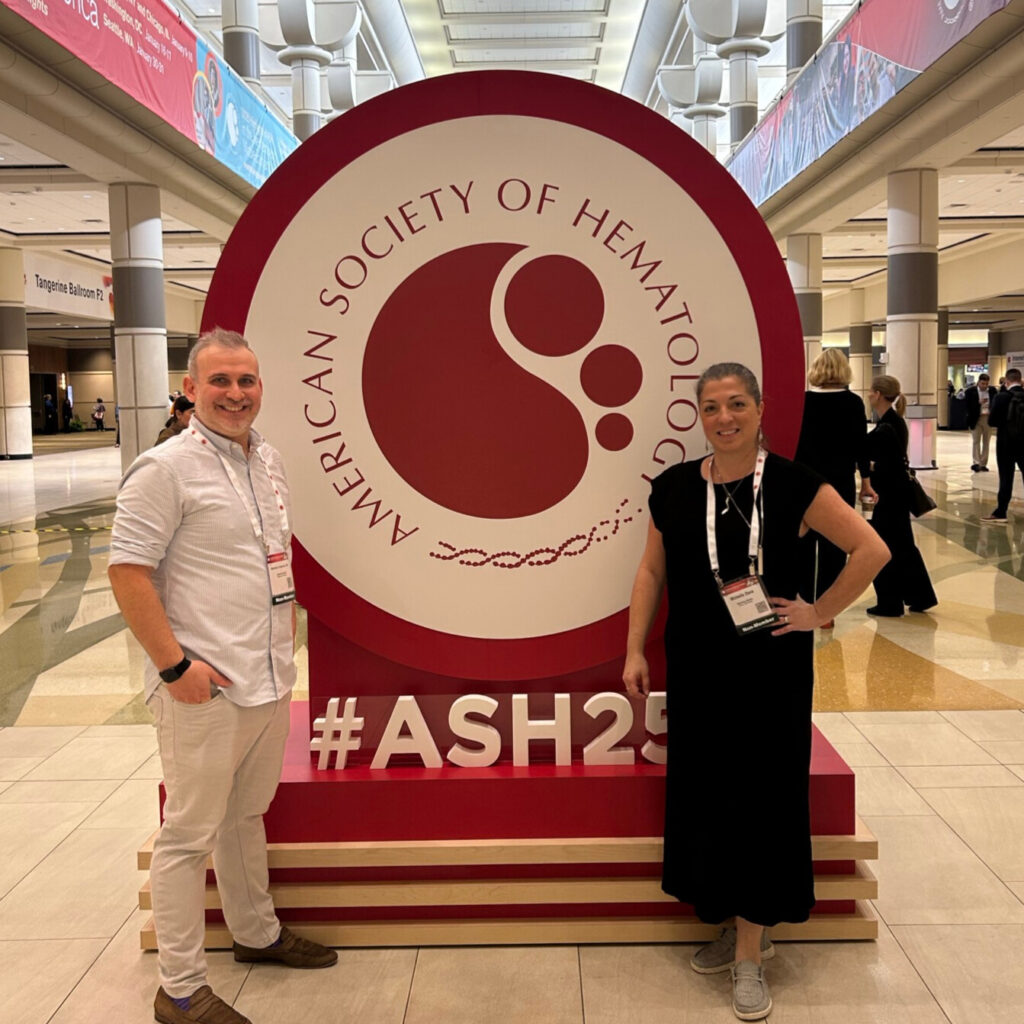
Myeloma Canada representatives joined thousands from the global hematology community at the 67th American Society of Hematology (ASH) annual meeting in December 2025, the largest hematology meeting in the world. Researchers and clinicians from around the globe shared important new findings in myeloma research, highlighting continued progress across treatment approaches and stages of disease.
While over 1500 myeloma abstracts were presented, the following represents our top highlights and most significant takeaways for the myeloma community.
Immunotherapy is revolutionizing care by prioritizing precision and quality of life.
A dominant theme at ASH this year was the fundamental shift toward using CAR T-cell and antibody-based therapies (e.g., bispecifics, trispecifics, antibody-drug conjugates) to achieve deeper responses that move the field toward a cure. At the heart of this shift is measurable/minimal residual disease (MRD) testing (i.e., the ability to detect even one cancer cell in 1 million cells) which has become an increasingly important treatment goal because it is a powerful predictor of long‑term survival. Researchers are now using MRD testing to guide personalized care. The precision offered by MRD testing allows for a major shift away from continuous treatment until progression toward shorter fixed-duration therapy and even treatment-free intervals, allowing patients to reclaim their quality of life.
CAR T-cell therapy is becoming more effective and safer.
Long-term follow-up data from the CARTITUDE-4 trial showed that when cilta-cel (a type of CAR T-cell therapy) is used at earlier relapse (1-3 prior lines of treatment) in standard-risk patients, 80.5% remained in remission 2.5 years after a single infusion. Furthermore, newer CAR T-cell therapies are emerging with unique binding mechanisms designed to improve safety. For instance, the iMMagine-1 trial with anito-cel (which uses a D-domain binder) showed very high response rates and, to date, has shown no delayed neurological side effects (e.g., parkinsonism, cranial nerve palsies, or Guillain-Barré syndrome), potentially making these powerful treatments a safer option for a broader range of patients.
Teclistamab plus daratumumab has set a new benchmark for early relapse for people with 1-3 prior treatments.
The MajesTEC‑3 trial showed that combining teclistamab with daratumumab provides much longer disease control than standard triplet therapy (such as daratumumab bortezomib and dexamethasone (DVd) or daratumumab pomalidomide and dexamethasone (DPd)) for people with relapsed or refractory myeloma. After three years, 83% of patients on this combination were alive and progression‑free, compared with about 30% receiving standard therapy. While infection risk was higher early on, these effects were generally manageable with routine preventive infection care, such as immunoglobulin replacement and antimicrobials.
There is new hope for overtaking high-risk extramedullary disease (EMD; an aggressive form of myeloma that grows outside the bone marrow).
Combining two different bispecific antibodies (talquetamab [targets GPRC5D] and teclistamab [targets BCMA]) achieved an overall treatment response rate of 78-79% in this high-risk population, with responses exceeding 90% for those with a lower disease burden. While this “double-targeted” approach requires careful monitoring for infections and routine preventive infection care, it represents one of the most effective treatments ever reported for patients with EMD, who have historically had very limited options.
CAR T‑cell therapy may one day be made directly inside the body.
The early-phase inMMyCAR study provided the first proof that CAR T‑cells can be generated directly inside a patient’s body using a single drug infusion called KLN1010. CAR T‑cell therapy normally requires T-cell collection, weeks of lab-based cell engineering, and pre‑infusion chemotherapy to prepare the bone marrow. With this new “in vivo” approach, those complex steps were skipped and the time from study consent to treatment was only 13-18 days. Importantly, this early report included only three patients, all of whom had high‑risk disease and multiple prior treatments and had not received BCMA‑targeted therapy before. All three patients reached MRD negativity within one month. While longer follow‑up and larger studies are needed, sustained responses could make this approach a major breakthrough in how CAR T‑cell therapy is delivered in the future.
More information
For a non-exhaustive global overview of the myeloma research presented at the conference, please consult the following resources by our global colleague organizations.
International Myeloma Foundation
Top Myeloma Research Presented at ASH 2025 Video
International Myeloma Working Group Conference Series: ASH 2025 – Making Sense of Treatment Video
ASH 2025 Breakthrough Myeloma Abstracts Blog
Facebook Live Video Replay from ASH 2025
Myeloma Patients Europe
ASH 2025 Myeloma Highlights Blog
ASH 2025 Myeloma Highlights Presentation
ASH 2025 Summary Video Interviews
HealthTree Foundation for Multiple Myeloma
Multiple Myeloma Research Foundation
Daily ASH 2025 Blog Posts
Frequently Asked Questions Video on Myeloma Highlights from ASH 2025