


October 22, 2025
Canadians with myeloma share their top takeaways from the International Myeloma Society annual meeting
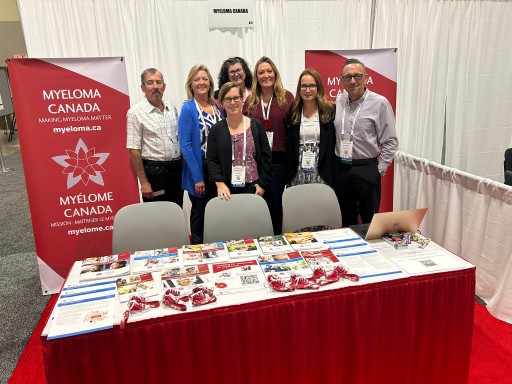
Each year, the International Myeloma Society (IMS) annual meeting brings together leading researchers, clinicians, industry partners, and advocates from around the world to share the latest breakthroughs in multiple myeloma. This year, a group of dedicated Myeloma Canada volunteers attended the conference and supported the Myeloma Canada booth on the trade floor throughout the event. We asked them for their reflections, and we are pleased to share their astute takeaways.
The evolving definition of “cure”
One of the most powerful themes to emerge from the conference was the growing confidence in the possibility of a cure. Brian Snowdon, Susan McDowell, Alyssa Dickey, and Yvette Webb all noted that sustained MRD (minimal/measurable residual disease) negativity is increasingly being viewed as a marker of remission, and potentially, cure.
MRD refers to the small number of myeloma cells that may remain in the body after treatment (often too few to be seen with standard tests). Highly sensitive laboratory technologies can now detect even one myeloma cell among 1 million normal cells in the bone marrow. If no myeloma cells are found with these advanced tests, this is called MRD negativity.
Reaching MRD negativity can be an important treatment goal, especially for people with high-risk myeloma. Moreover, several new clinical trials are now using MRD results to decide whether to increase (escalate) or reduce (de-escalate) treatment.
Brian summed it up with excitement: “Work with drug combinations and treatments is making it necessary to define what a cure looks like. Sustained MRD negativity is part of it. But from a patient’s perspective it would include the near absence of side effects and almost no limitations to quality of life. The fact that a definition is needed gives hope for a future that is not really that far off.”
MRD testing is changing the game
MRD testing was a hot topic at IMS, with Brian, Susan, and Alyssa all highlighting its role in guiding treatment decisions. Brian described MRD testing as a “game changer,” especially with the potential for blood-based assays that could replace more invasive bone marrow biopsies.
Although MRD testing is not yet the standard of care for myeloma in Canada, this November Myeloma Canada will host an MRD Summit, bringing together key researchers, industry partners, government representatives, and patients to discuss the best approach for implementation in Canada, a first and much-needed meeting bringing together key decision-makers and leading experts on this topic.
CAR T-cell therapy
CAR T-cell therapy is a personalized immunotherapy where some of the patient’s white blood cells called T-cells are genetically modified to better recognize and attack certain cancer cells. There are different types of CAR-T therapies in development that target specific protein markers found on the myeloma cell (BCMA or GPRC5D).
Tanya Zigomanis shared her excitement about two new CAR T-cell therapies that showed impressive response rates and fewer side effects. “Anito-cel, targeting BCMA, showed a 95% overall response rate with minimal toxicities. Arlo-cel, targeting GPRC5D, demonstrated efficacy in BCMA-exposed patients with an overall response rate of 79% with fewer infections,” she explained. BCMA-exposed refers to someone who has previously been treated with BCMA-targeted therapies.
Patients are being heard
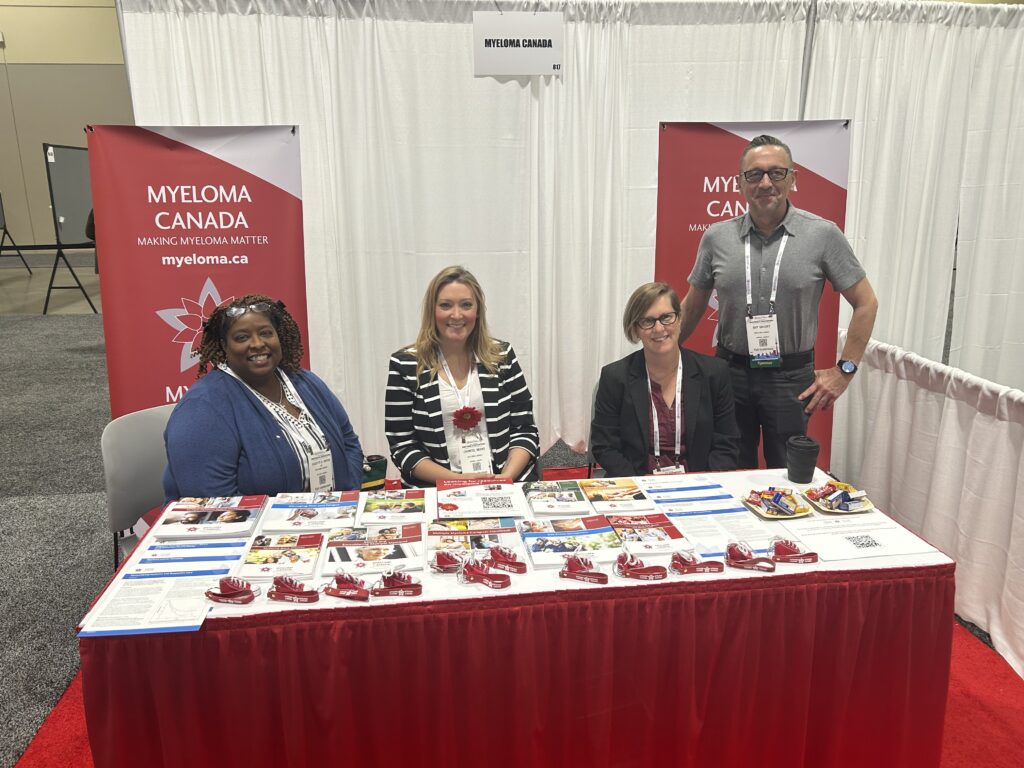
[Photo : Jules Royer, Chantel Wicks (Myeloma Canada), Alyssa Dickey and Guy Gaudet (Myeloma Canada) at the IMS annual meeting]
The importance of patient experience and shared decision-making was another key theme. Jules Royer and Tanya both reflected on studies showing that patients prioritize quality of life, side effects, and treatment convenience more than physicians might expect.
Jules was very interested in a survey of physicians and patients on shared decision-making in relapsed/refectory multiple myeloma (which included our CEO Martine Elias). Jules spoke directly about what matters to her and her peers when she said, “us patients, place a greater emphasis on factors such as quality of life, side effects and treatment conveniences, compared to physicians.”
Expanding access to treatment
Volunteers were heartened to see that newer treatments are being offered to a broader range of patients. Alyssa highlighted that immunotherapies are now being considered for older and frailer patients, challenging outdated age caps on procedures.
“We heard that a patient may be over 70 years old but have a young immune system and many active T-cells, so CAR-T should be offered,” she wrote. “This is in contrast to age caps seen with autologous stem cell transplant, for example.”
Prophylactic support is gaining attention
While many presentations at IMS focused on new treatments, volunteers were also encouraged by the growing attention to proactive care strategies that help prevent complications before they arise. Tanya highlighted several studies exploring prophylactic support for myeloma patients, including the use of immunoglobulin replacement therapy and preventative antibiotics to reduce the risk of infections — an issue that often accompanies immunotherapy treatments.
Immunoglobulin replacement therapy (often referred to as IVIg) is a treatment where antibodies are given to myeloma patients to help protect them from infection when their immune system is weakened by the disease or its treatments.
“Prevention of infection versus reaction after the fact is something we want to see more of as patients, so it’s comforting that this issue is being examined carefully,” Tanya said.
Thank you to our volunteers
We extend our heartfelt thanks to the volunteers who represented Myeloma Canada at the IMS Annual Meeting: Brian Snowdon, Susan McDowell, Alyssa Dickey, Jules Royer, Yvette Webb, and Tanya Zigomanis. Your thoughtful reflections, enthusiastic engagement, and energetic work at the Myeloma Canada booth made a lasting impression on the international researcher community. You not only helped raise awareness of Canadian perspectives in the global myeloma community, you also showed the world how passionate and informed our community truly is.
Thank you for your dedication and for being such outstanding ambassadors for Canadians living with myeloma.