


August 19, 2026
Myeloma Canada’s Advocacy Handbook: Newly updated!
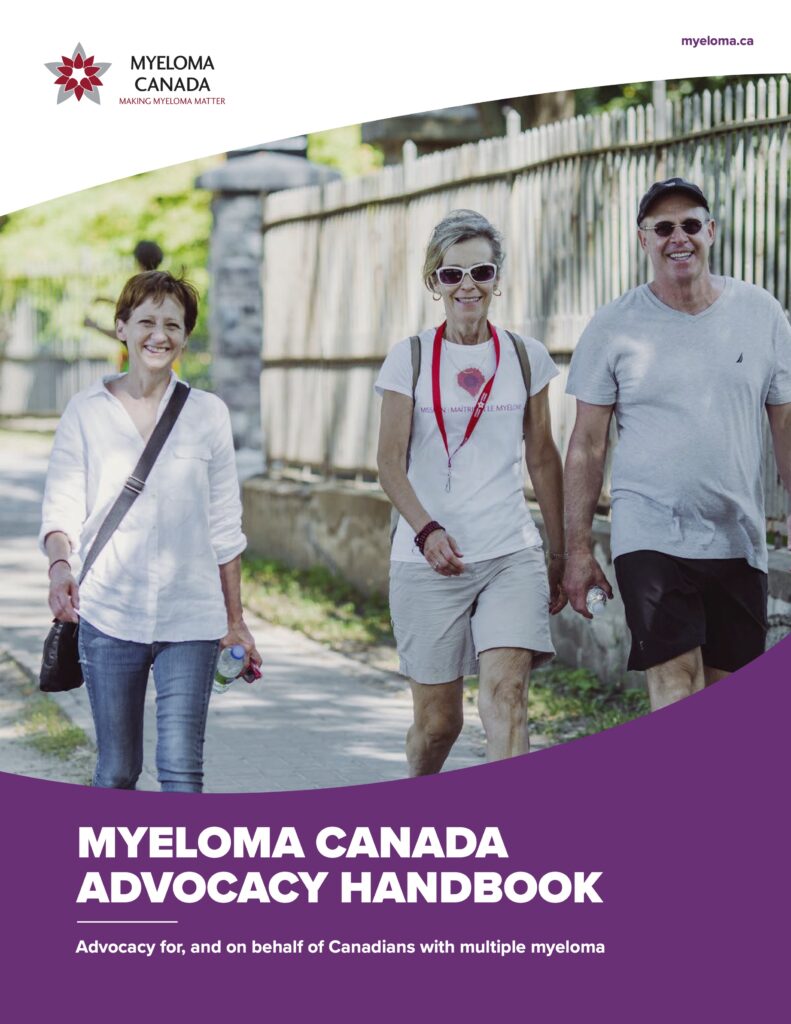
Myeloma Canada’s National Advocacy Committee is proud to announce the release of a newly updated Advocacy Handbook for Canadians affected by myeloma. This Handbook replaces the 2022 edition and is the result of six months of in-depth review and re-development by members of the National Advocacy Committee. Myeloma Canada would like to extend our sincere thanks to all committee members for their hard work and thoughtful contributions to this project.
The following is a message from the National Advocacy Committee.
We’ve updated the Handbook!
By Myeloma Canada’s Advocacy Committee
Why the Advocacy Handbook was updated
Recent years have seen remarkable advances in how myeloma is treated, yet systems rarely keep pace with science, and access to innovation remains inconsistent across the country.
In this moment, as new treatments and technologies continue to reshape the standard of care, advocacy is becoming an increasingly valuable skill for patients and families. It helps us recognize when we are receiving the best possible care and treatment and allows us to hold our systems accountable if we’re not.
At the same time, we as patients know firsthand that advocacy looks different for everyone and can easily feel out of reach. For example, Canada’s complex health systems shape how every one of us living with myeloma receives care, yet information about them can be both overwhelming, and hard to find. This means seeking the information you need to advocate often reinforces the feeling that you’re not an advocate, or that you alone can’tmake a difference.
Our goal in updating the Handbook was to make advocacy accessible to as many people as possible, we hope it will both empower community members to see the ways in which they’re already an advocate and give them the tools to make their voices heard even more effectively.
What’s new?
This update includes:
- an expanded section on understanding Canada’s health systems
- updated tools and strategies for advocating effectively at any level
- an example advocacy letter written by a community member which successfully secured a meeting with decision-makers.
If you’re not sure where to start, the ‘Personal Advocacy Compass’ exercise can help you get a sense of your personal advocacy priorities, and the ‘3 P’s: Participate, Partner, Post’, section breaks down a few simple ways to stay engaged with advocacy issues you care about.
Final thoughts
Working on this handbook, we were frequently reminded that despite being such a broad and seemingly complicated concept, advocacy can be as simple as asking a question.
Some of us joined the Advocacy Committee not feeling like “real” advocates at all, but gaining knowledge changed that. The more we’ve learned, the less intimidating advocacy has felt, and through the Handbook, we hope to share a bit of this experience with our community.
Download the newly updated Myeloma Canada Advocacy Handbook.